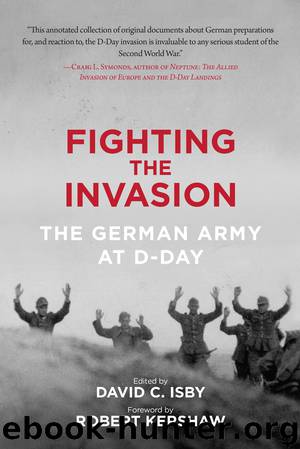
Fighting the Invasion by David C. Isby
Author:David C. Isby
Language: eng
Format: epub
ISBN: e9781510703667
Publisher: Skyhorse Publishing
Published: 2016-02-16T05:00:00+00:00
II. Preparations
1. Reflections on concentrations
The 21st Panzer Division knew that, due to its composition of vehicles, it would be far more likely to be committed in the West than in the East. Despite this, the creation of spare parts depots and a particularly well-equipped and far-seeing spare parts echelon opened possibilities for all sorts of employment.
In March 1944, the division was transferred to Hungary, but this transfer was rescinded when the division had gone half way, and it was turned round and started on the return trip. This transfer had temporarily taken the mind of the divisional staff off its particular suitability for commitment in the West.
During the long wait in the West, the leaders of the division had given serious consideration to the problem of the best employment of a Panzer division in case of invasion. Apart from that, as already mentioned, it had suffered a lot from the continuous change in the strategic intentions of its superiors due to the frequent changes of station.
To its superiors, the staff of the division always represented the viewpoint that a Panzer division should not be standing in readiness near the coast. Such a disposition would, however, be justified if it had been ascertained that the invasion would take place in this locality. In that case, however, the division would have to be as near to the coast as was possible, if they were at the same time to be just outside the area which would be subject to pattern bombing on coastal defenses. Under certain circumstances, such a concentration of tanks could even have changed the invasion plan, as was proved by the 21st Panzer Division on the occasion of trying out their special weapons on 1 June 1944. Tracks of armored vehicles seen going towards the coast near Lion-sur-Mer (aerial photographs) caused the Allied High Command to assume that armored reserves had been put ready just at that point, and resulted in talks concerning a possible shifting of the sector to be attacked. The CG of the division heard this from the G-2 of the Canadian Army in the course of talks about the history of the war in POW Camp II in England.
Assembling in readiness any farther away would necessitate a longer march to reach the enemy once he had landed, but that had to be put up with. The staff of the division stressed that, under all circumstances, it should have the possibility of attacking the enemy, once landed, in his weakest spot with its full assembled weight, regardless of any strategic considerations which would be a matter for the higher command.
There were, however, two prerequisites to hitting the enemy with the full weight:
a.Terrain favorable for tanks.
b.That the division would not be kept in readiness for any tactical purposes.
Not in readiness for defensive purposes means to put the division in readiness in such a way that at the time of an enemy landing, or in case of any tactical parachute landings, no parts of the division would immediately be involved in the fighting.
Download
This site does not store any files on its server. We only index and link to content provided by other sites. Please contact the content providers to delete copyright contents if any and email us, we'll remove relevant links or contents immediately.
| Africa | Americas |
| Arctic & Antarctica | Asia |
| Australia & Oceania | Europe |
| Middle East | Russia |
| United States | World |
| Ancient Civilizations | Military |
| Historical Study & Educational Resources |
The Radium Girls by Kate Moore(12035)
100 Deadly Skills by Clint Emerson(4931)
Rise and Kill First by Ronen Bergman(4797)
The Templars by Dan Jones(4694)
The Doomsday Machine by Daniel Ellsberg(4493)
The Rape of Nanking by Iris Chang(4222)
Killing England by Bill O'Reilly(4008)
Stalin by Stephen Kotkin(3973)
Hitler in Los Angeles by Steven J. Ross(3949)
12 Strong by Doug Stanton(3554)
Hitler's Monsters by Eric Kurlander(3347)
Blood and Sand by Alex Von Tunzelmann(3207)
The Code Book by Simon Singh(3197)
Darkest Hour by Anthony McCarten(3135)
The Art of War Visualized by Jessica Hagy(3014)
Hitler's Flying Saucers: A Guide to German Flying Discs of the Second World War by Stevens Henry(2758)
Babylon's Ark by Lawrence Anthony(2685)
The Second World Wars by Victor Davis Hanson(2529)
Tobruk by Peter Fitzsimons(2521)
